Digital marketing matters for manufacturers because large buyers now check a supplier online before they ever call. Your website, your Google results and how AI assistants describe your company often decide whether you make the shortlist. For a manufacturer that wants bigger clients, a fast, SEO-ready website is part of the sales team.
Many factories in Vapi, Silvassa, Daman and across India still win most of their business through contacts, agents and trade fairs. That still works. But the way large companies choose suppliers has changed, and the change is easy to miss because the lost enquiries never reach you.
Big clients check you before they call
When a procurement or engineering team at a large company looks for a new supplier, the first step is usually research, not a phone call. They look at your website, search your company name, check what you make, which industries you serve, your certifications and your capacity. Only then do they decide whether to send an RFQ or plan an audit visit.
Research backs this up. In a Gartner survey of 632 B2B buyers, published in June 2025, 61% said they prefer a buying experience without a sales rep, and most prefer to research independently through digital channels. The same survey found that 69% of buyers had noticed inconsistencies between a supplier's website and what its sellers told them. An outdated website does not just look old; it can make buyers doubt what your team says.
Before an RFQ, a buyer's team typically checks:
- Product range, grades and sizes, for example API intermediates, reactive dyes, HDPE drums, PP woven bags or CNC-machined parts.
- Capacity, such as tonnes per month or pieces per shift, and how quickly you can scale for a large order.
- Certifications you actually hold, such as ISO 9001, ISO 14001, GMP or BIS, and your testing facilities.
- Export experience and documentation, and your distance to ports such as Nhava Sheva (JNPT) or Hazira.
- A named contact and how quickly enquiries are answered.
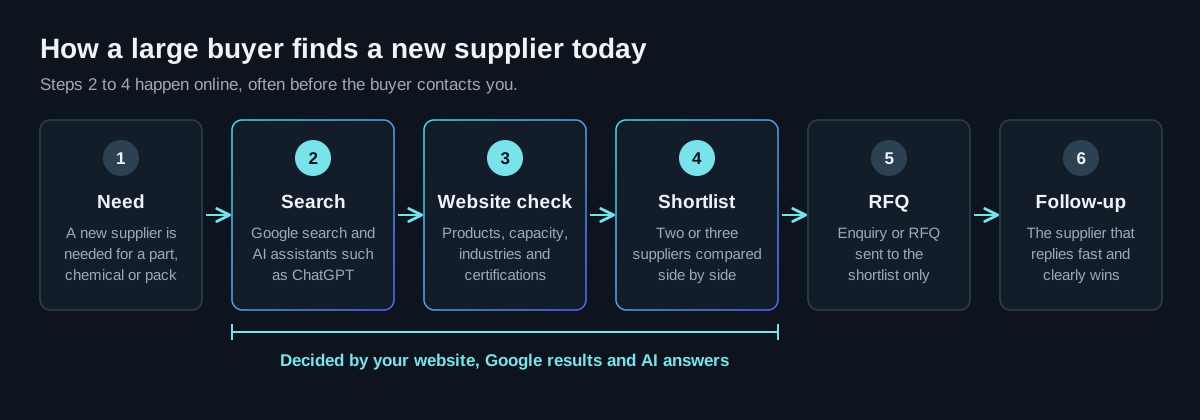
Referrals and trade fairs are no longer enough on their own
Even a warm referral gets searched. A buyer who meets you at an exhibition will look you up afterwards and compare you with two or three other suppliers. If your website has one page, no product details and a broken contact form, the comparison is over before it starts.
- A referral brings the buyer to your website; the website decides whether they contact you.
- Buyers compare suppliers side by side, often without telling you.
- Clear product, capacity and quality information saves both sides time and builds trust.
This matters especially around Vapi. Vapi GIDC is known for chemicals, dyes and pharma; Silvassa for textiles, yarn and plastics; Daman for pharma and plastics. A buyer looking for any of these products can find many suppliers within a short drive, so the clearest website often gets the first call.
Example: two suppliers, one RFQ
Imagine a procurement manager at a large pharma company in Mumbai who needs a new supplier of HDPE bottles. They search 'HDPE pharma bottles manufacturer Gujarat' and ask ChatGPT the same question. Supplier A has a one-page website with a phone number. Supplier B has a page for HDPE bottles listing sizes from 30 ml to 1 litre, its clean moulding area, its ISO 9001 certificate, monthly capacity and an RFQ form. Supplier B gets the RFQ, even if Supplier A makes a better bottle. This is an illustrative example, not a real case.
The new shortlist: AI assistants
Buyers increasingly ask ChatGPT, Gemini or Google's AI answers questions such as 'Who makes PP woven bags near Vapi?' or 'Which chemical suppliers in Gujarat are ISO certified?'. A Responsive survey of 350 B2B buyers, published in October 2025, found that generative AI has overtaken traditional search for about a quarter of buyers, and nearly two-thirds use it as much as or more than search when researching vendors.
The same survey found that at companies with 2,000 or more employees, 42% use generative AI for vendor discovery, compared with 18% at companies with 501 to 1,000 employees. In other words, the bigger the client, the more likely their team uses AI to find suppliers. These surveys cover buyers across regions and industries, not only Indian manufacturing, but the direction is clear. AI assistants can only recommend you if your website explains clearly what you make and where you are.
What an SEO-ready manufacturing website looks like
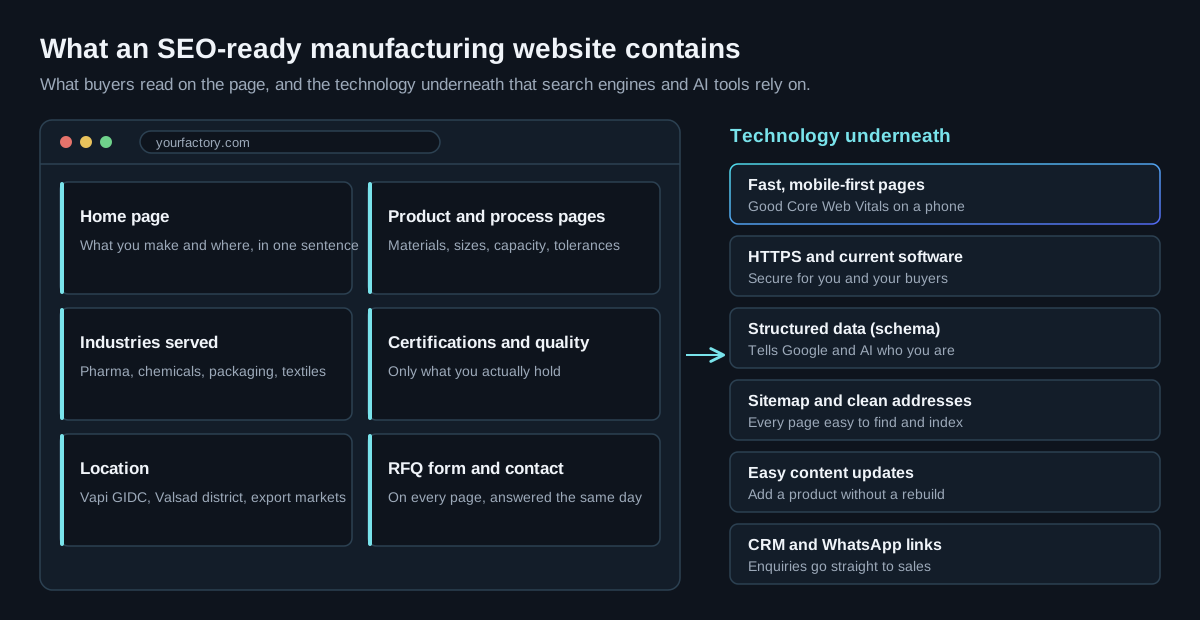
SEO (search engine optimisation) for a manufacturer is not about tricks. It is about making your capabilities easy for buyers, Google and AI assistants to understand. In practice that means:
- A separate page for each product or process, with materials, sizes, capacity and tolerances.
- Pages for the industries you serve, such as pharma, chemicals, packaging, textiles or engineering.
- Certifications, quality systems and testing facilities stated clearly, with only what you actually hold.
- Your location and service area, for example Vapi GIDC, Valsad district or export markets.
- A clear enquiry or RFQ form and visible contact details on every page.
- Unique page titles and descriptions, one main heading per page and a sitemap Google can read.
- Structured data that tells search engines and AI tools who you are, what you make and where you are.
- Short, direct answers to common buyer questions, so AI assistants can quote them.
Why the technology behind your website matters
Two websites can look similar and still perform very differently. The technology underneath affects speed, security, how easily you can update it and how well search engines read it. Google says its core ranking systems look to reward a good page experience, and that Core Web Vitals, which measure loading speed, responsiveness and visual stability, are used by those systems.
- Speed: pages that load quickly on a phone keep busy buyers reading.
- Security: HTTPS and up-to-date software protect your site and your buyers' trust.
- Mobile: many buyers first see your site on a phone, often between meetings or on the shop floor.
- Easy updates: adding a new product or certification should not need a full rebuild.
- Clean structure: search engines and AI tools read well-structured pages more reliably.
- Connections: enquiries can flow straight into your CRM, email or WhatsApp instead of a forgotten inbox.
A modern stack does not have to mean an expensive one. For example, a site built with a modern framework such as Next.js can be published as fast static pages, served over HTTPS, with schema.org structured data, an XML sitemap and an llms.txt file for AI tools. This website, dynovertex.com, is built that way. The goal is a site that is fast, secure, easy to keep accurate and ready to connect to the tools your sales team already uses.
Turning website visits into orders
Traffic alone does not win orders. What matters is what happens after a buyer fills in your form. If enquiries sit in an inbox for two days, a competitor may already have replied. Lead generation software can capture every enquiry from your website, ads and social media in one place, show your team who needs a reply, and send automatic WhatsApp, SMS or email follow-ups so no buyer is left waiting.
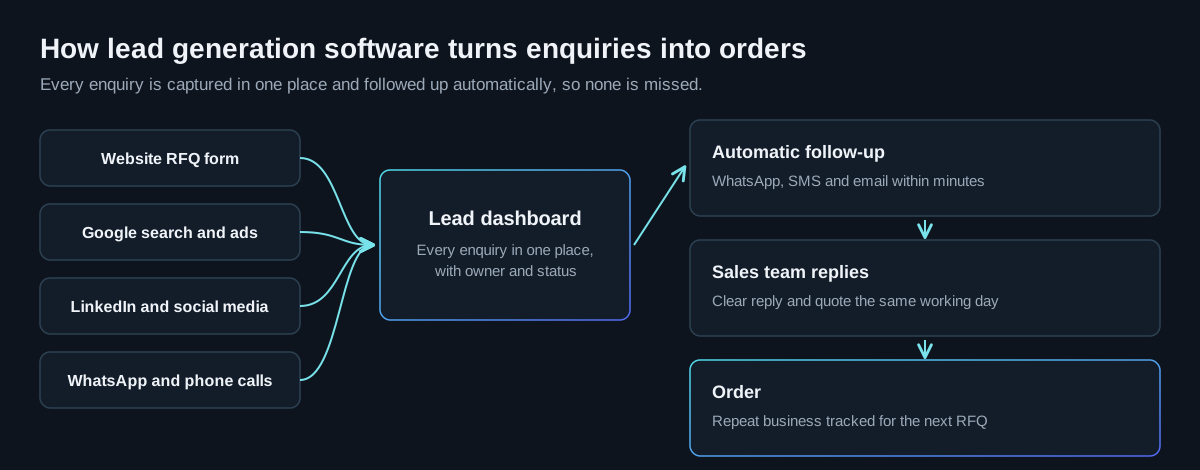
A simple target helps: acknowledge every RFQ automatically within minutes, and send a clear reply or quote within one working day. Lead generation software makes that target easy to track, because every enquiry has an owner and a status.
A quick checklist for your manufacturing website
- Does your home page say in one sentence what you make and where you are?
- Does each main product or process have its own page with real specifications?
- Are your certifications and industries served clearly listed?
- Does the site load quickly and work well on a phone?
- Does it use HTTPS and show no security warnings?
- Do your page titles describe what you make, not just your company name?
- Is there a simple RFQ or enquiry form, and does someone reply the same day?
- Does a search for your company name show your own website first?
- Does an AI assistant describe your company correctly when asked?
- Is the information on your website the same as what your sales team says?
If you answered no to three or more, your website may be costing you enquiries from exactly the larger clients you want.
Common questions
Is SEO worth it for a B2B manufacturer with few, large clients?
Yes. You may only need a handful of the right buyers, but each one will check you online before contacting you. SEO makes sure they find accurate, convincing information when they do.
How long does SEO take to show results?
Technical fixes can go live in the first few weeks. Stronger search and AI visibility usually builds over several months of steady work, which is why our plans start with a 90-day plan and a minimum of three months. Nobody can honestly guarantee a ranking.
Do manufacturers need to run ads?
Not always. Ads can bring faster enquiries for specific products, but a clear, SEO-ready website should come first, because that is where ad clicks land.
What should a manufacturer put on a product page?
The product name buyers search for, grades or sizes, materials, capacity, the standards and certifications you hold, the industries it is used in, packaging and delivery options, and a clear RFQ button.
Does an export-focused manufacturer need SEO too?
Yes. Overseas buyers usually cannot visit your plant first, so they rely even more on your website, your certifications and how AI assistants describe you. Clear English product pages and export documentation details matter even more.
How DYNOVERTEX can help
DYNOVERTEX is a software and digital marketing company in Vapi, Gujarat. We can review your website, fix what holds it back in Google and AI answers, write product and industry pages, and set up lead generation software so every enquiry is followed up. Our digital marketing plans start at ₹20,000 a month plus GST. If you want bigger clients to find and trust your factory online, tell us what you make and who you want to sell to.